
Phuket’s long-running hotel licensing backlog is being cleared at a dramatically faster pace, with the Thai government announcing that 275 hotel permits have been issued in just two months as authorities simultaneously intensify investigations into nominee businesses and unlicensed tourism operations across the island.
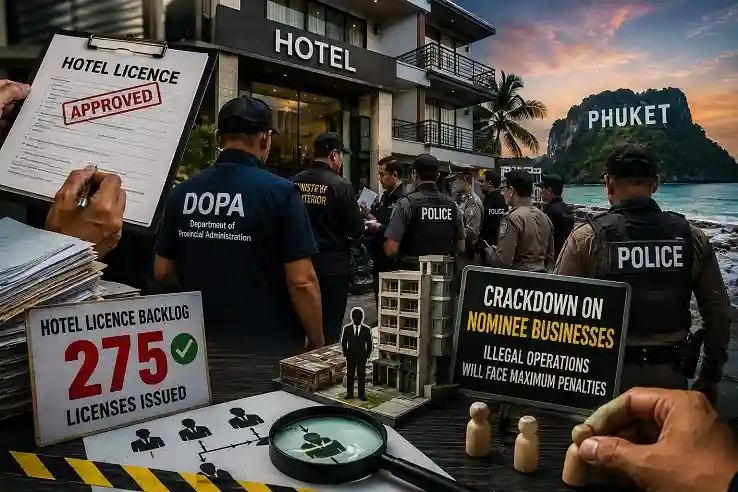
Image Credit: Phuket Hotel News
According to this Phuket Hotel News report, the accelerated campaign has already dealt with more than 75 per cent of 392 hotel permit applications that had remained pending since 2018. Government officials say the remaining 117 applications are expected to be reviewed and resolved by September 2026, potentially bringing an end to a licensing bottleneck that has persisted for years.
Government Accelerates Phuket Hotel Licensing
Deputy government spokesperson Ploytalay Laksameesaengjan announced the progress on August 12, saying the government had prioritized the regulation of Phuket’s accommodation sector under instructions from Prime Minister and Interior Minister Anutin Charnvirakul.
The figures highlight the scale of the acceleration. Phuket previously processed approximately 30 to 40 hotel licenses annually, according to the government. By comparison, authorities have issued 275 licenses during the latest two-month intensive campaign.
For Phuket’s hospitality industry, the initiative could have significant consequences. The island has experienced enormous expansion in hotels, villas, apartments and other accommodation businesses over the years, while some operators have encountered complicated regulatory requirements involving hotel licensing, building permissions and other legal approvals.
Bringing more properties into the formal licensing system could strengthen oversight while providing legitimate operators with greater regulatory certainty.
Remaining 117 Applications Targeted for September
Of the original 392 pending hotel applications, 117 remain unresolved. The government expects the review process to be completed by September 2026.
Authorities are also examining the legal and regulatory obstacles encountered by businesses attempting to obtain hotel licenses. Information is being collected with the possibility of proposing amendments or improvements to existing rules.
Ploytalay said the government wants operators to enter the formal system while maintaining safety standards and eliminating bribery and improper payments. Officials have also stressed that regulatory reform will not mean relaxing enforcement against businesses found to be deliberately operating illegally.
The distinction is important for Phuket, where authorities are attempting to address legitimate licensing difficulties while simultaneously taking tougher action against businesses suspected of circumventing Thai laws.
Nominee Business Investigations Expand Across Phuket
The hotel licensing campaign is unfolding alongside a broader crackdown on suspected foreign nominee business structures.
Authorities have been examining companies allegedly using Thai shareholders or representatives as nominees to circumvent restrictions governing foreign ownership and business activities. The investigation, which initially focused on around 300 entities, has reportedly expanded to scrutiny of 391 companies across Phuket.
The enforcement campaign followed complaints involving allegedly illegal business operations, construction and licensing irregularities, and concerns over foreign-controlled businesses operating through Thai nominees.
The issue has become increasingly prominent as Phuket’s booming tourism economy continues to attract substantial domestic and international investment.
For legitimate foreign investors, the campaign also underscores the importance of ensuring that ownership structures, operating licenses, construction approvals and business activities comply fully with Thai law.
Inspections Target Hotels Villas Restaurants and Tourism Businesses
Authorities have widened inspections beyond conventional hotels.
More than 361 businesses considered potentially high-risk have reportedly come under increased scrutiny, with enforcement covering unregistered hotels, luxury villas, tourism businesses, restaurants and companies suspected of concealing foreign control through nominee shareholding arrangements.
The intensified inspections followed several developments, including the discovery of two hotels allegedly operating without valid hotel licenses or required building permits.
The government’s enforcement campaign was further broadened following a widely reported incident during an inspection at Chabad House in Patong, where an individual reportedly challenged the authority of Thai officials conducting checks.
Officials subsequently expanded their examination of businesses considered vulnerable to regulatory violations or nominee ownership arrangements.
Police Investigations Already Underway
Several cases identified during the wider enforcement operation have already entered the police investigation process, while evidence continues to be collected in other cases.
Government representatives have indicated that authorities intend to pursue violations where sufficient evidence is established rather than treating the current operation as a temporary inspection campaign.
Anutin has emphasized strict enforcement as part of the government’s efforts to protect legitimate businesses and ensure that commercial activity complies with Thailand’s laws.
At the same time, officials appear to recognize that Phuket’s hospitality sector faces genuine regulatory challenges. The government’s decision to collect information about obstacles encountered by hotel operators could therefore become an important second phase of the campaign.
If cumbersome or conflicting regulations are identified, legislative or administrative changes could potentially make it easier for legitimate businesses to enter the formal system without compromising building, fire, guest or public safety requirements.
A Major Shift for Phuket Hospitality
Clearing 275 applications in two months represents a striking change from the previous pace of only 30 to 40 licenses annually. If authorities succeed in processing the remaining 117 applications by September, Phuket could finally close a substantial administrative backlog that dates to 2018.
The larger question will be what happens after the backlog disappears. Phuket’s accommodation market continues to evolve rapidly, particularly with the growth of villas and alternative accommodation models that do not always fit neatly into traditional hotel classifications.
The government therefore faces a balancing act: simplifying legitimate licensing, maintaining rigorous safety standards, preventing corruption and ensuring that foreign investment operates through lawful ownership structures.
For established hotel operators, investors and tourism businesses, the current campaign sends a clear message that Phuket is entering a period of more intensive regulatory scrutiny. At the same time, faster processing of legitimate applications could make the licensing environment more predictable and reduce the incentive for businesses to remain outside the formal system.
With the government aiming to finish the remaining applications by September 2026 while police and administrative investigations continue across the island, the coming weeks could prove important for Phuket’s hotel and tourism sectors. Successful reform will ultimately depend not only on clearing old applications, but also on creating a licensing system capable of handling future growth efficiently, transparently and fairly while ensuring that businesses operating illegally face consistent enforcement.