
Phuket’s hospitality calendar is once again filling with conferences, workshops, sustainability programmes, networking sessions and industry gatherings promising to address everything from environmental responsibility and inclusive sourcing to food and beverage innovation and the future direction of the island’s tourism sector. There is certainly no shortage of discussion. The more uncomfortable question is whether all this talking, networking and presentation-making is producing measurable improvements for Phuket itself.
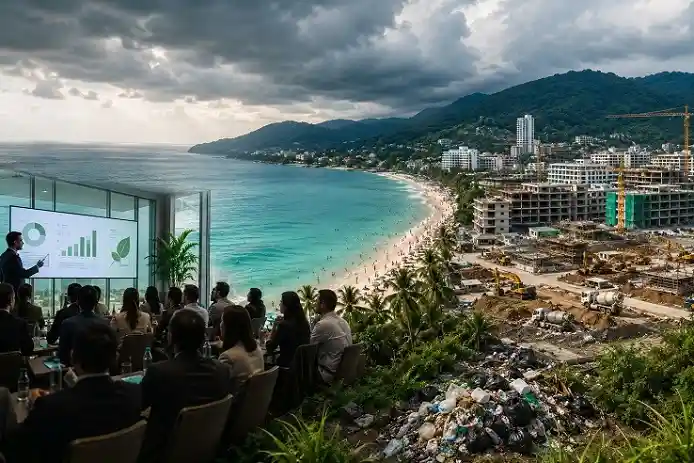
Image Credit: Phuket Hotel News
Against this increasingly busy backdrop, this Phuket Hotel News report asks a question that perhaps deserves considerably more attention: after years of hospitality conferences, sustainability forums, industry panels and leadership gatherings, what tangible difference have they actually made to Phuket’s development trajectory, infrastructure, communities and environment?
A Busy Calendar of Hospitality Initiatives
There is no question that some worthwhile subjects are being placed on the table.
The Phuket Hotels Association recently listed a UN Women-supported workshop on “Deepening Learning & Mapping of Inclusive Sourcing in the Hospitality Industry,” held on August 4, while another event, “Plant-Forward Excellence,” is scheduled for August 19 at M Social Hotel Phuket, focusing on guest experience, sustainability and F&B revenue.
The environmental calendar is equally active. PHIST – Phuket Hotels for Island Sustaining Tourism 2026 is scheduled for September 7 at Angsana Laguna Phuket, followed by an island-wide Phuket Green Day tied to World Cleanup Day on September 18 and another Green Day in December.
Earlier this year, Phuket also hosted the GSTC2026 Global Sustainable Tourism Conference from April 21-24. According to the Global Sustainable Tourism Council, 575 delegates representing more than 55 countries attended, with discussions centered on Sustainable Hospitality, Resilient Cities & Communities, and Carrying Capacity & Visitor Distribution Management.
These are highly relevant subjects. But relevance of subject matter and effectiveness of outcome are two very different things.
Phuket Does Not Need More PowerPoint Sustainability
For more than a decade, Phuket has witnessed a procession of tourism conferences, hotel gatherings, property forums and sustainability events. Industry veterans appear on panels, executives present case studies, photographs are taken, sponsors receive exposure and participants network over coffee, cocktails and carefully prepared dinners.
Some organizations have unquestionably built substantial hospitality portfolios and industry influence. But longevity and commercial success should not automatically grant anyone permanent authority over Phuket’s future.
The danger is the emergence of an industry echo chamber in which the same established personalities repeatedly tell the same audience how Phuket should develop, while the physical evidence outside the conference venue suggests that the island still faces serious structural problems.
A beautifully designed presentation about sustainability does not make Phuket sustainable.
The Island Outside the Conference Room
Drive around Phuket and the contradiction is difficult to ignore.
Hotels, condominiums, villas, retail developments and other projects continue appearing across the island. Individually, many are attractive developments. Collectively, however, the question becomes considerably more complicated: how much development can Phuket realistically accommodate before infrastructure, communities and natural resources begin paying the price?
Water is one obvious concern. Academic research examining Phuket’s hotel sector and tourism carrying capacity estimated water consumption among 178 hotels subject to environmental impact assessment requirements at approximately 24,275 cubic metres per day during low season and 40,457 cubic metres during high season.
Waste is another. Reuters reported in 2025 that Phuket was generating more than 1,000 tonnes of garbage every day, with rapid tourism-driven development putting increasing pressure on the island’s waste-management capacity. Officials warned that daily waste volumes could climb substantially further without stronger intervention.
These are not theoretical sustainability issues suitable only for conference panels. They are physical constraints.
If Phuket continues adding accommodation, residences, restaurants, shopping developments and tourism facilities without matching investment in water, wastewater treatment, electricity, roads, public transport, drainage and waste processing, the island risks progressively undermining the very environment on which its hospitality economy depends.
Where Is the Scorecard?
Perhaps every major hospitality conference in Phuket should be required to answer one simple question a year later: what changed?
How much waste was eliminated?
How much hotel wastewater was treated or reused?
How many local people received permanent employment rather than temporary publicity-driven opportunities?
How much purchasing was transferred to Phuket farmers, fishermen, producers and small businesses?
How many beaches, reefs, mangroves or other ecosystems measurably improved?
How much water consumption per occupied hotel room was reduced?
How many recommendations made at previous conferences became actual policy?
Without transparent benchmarks and follow-up reporting, sustainability risks becoming another marketing vocabulary — something discussed enthusiastically on stage but difficult to identify on the ground.
Phuket’s Problems Extend Beyond Hotels
There is another issue the hospitality industry cannot conveniently separate from Phuket’s development story: governance and enforcement.
Thai authorities have intensified action against illegal businesses and suspected nominee structures. In January, Thailand’s Public Relations Department reported Phuket operations targeting call-center scams, mule-account networks and alleged nominee arrangements involving foreign-controlled businesses.
More recently, the Department of Business Development and Royal Thai Police investigated 66 companies in Phuket and Krabi suspected of nominee arrangements involving land and real estate valued at more than one billion baht.
Another 4700 plus hotels real estate companies and business across Phuket are also under investigations.
These investigations should not be used to characterize Phuket generally as a criminal destination, nor should allegations be treated as convictions. They do, however, demonstrate why stronger corporate transparency, land-use enforcement and scrutiny of business structures have become increasingly important as enormous amounts of capital continue flowing into southern Thailand’s tourism and property markets.
Perhaps Phuket Needs Different Voices
There is also a legitimate argument for bringing a new generation of hospitality professionals, urban planners, environmental scientists, community representatives and independent researchers into the conversation.
Phuket should not become an industry club where influence depends primarily on how long someone has occupied a senior position, how many properties a company manages or how frequently a particular executive appears on a conference stage. Its tiring to see dinosaurs or potato-heads trying to dominate the hospitality industry in Phuket.
Experience matters. Institutional knowledge matters. But so do new ideas.
Young Thai hospitality professionals, environmental specialists, architects, infrastructure planners, local entrepreneurs and community leaders may view Phuket’s challenges very differently from executives whose primary responsibility is understandably commercial performance. Their voices deserve substantially more space.
Development Should Come with Obligations
Perhaps the debate also needs to move beyond whether Phuket should continue developing and towards what every new development should be required to contribute.
Large new hotels and property projects could face tougher infrastructure and environmental conditions proportional to their impact. Requirements might include water recycling, wastewater capacity, renewable-energy targets, waste reduction, employee transport, local procurement, community contributions, green-space protection and independent environmental monitoring.
More importantly, regulations need enforcement.
There is little value in repeatedly discussing carrying capacity while approving development as though carrying capacity were an academic concept rather than a physical limit.
Interestingly, even the GSTC conference held in Phuket this year explicitly included “Carrying Capacity & Visitor Distribution Management” among its three principal themes.
The next step should therefore be translating discussion into numbers: How many additional hotel rooms can each part of Phuket sustainably support? How much water is available? What wastewater capacity exists? What traffic will developments generate? What ecological areas should simply be off-limits?
Those questions are considerably harder than organising another panel discussion.
Events Can Help — But They Must Prove Their Value
None of this means hospitality events are inherently pointless. Good conferences can spread knowledge, connect decision-makers, introduce technologies, raise funds, create partnerships and accelerate change. Phuket’s hospitality sector also benefits from having organizations capable of bringing international expertise to the island.
The problem arises when events themselves become the achievement. A conference hall full of delegates is not evidence of sustainability. A photograph of executives planting trees is not an environmental strategy. A panel about local communities is not proof that communities benefited. A slide showing corporate sustainability targets is not independently verified environmental performance.
If organizers genuinely want these events to shape Phuket’s future, perhaps every conference should publish measurable objectives before opening its doors and a public progress report six or twelve months afterwards.
That would transform hospitality gatherings from networking occasions into mechanisms for accountability.
Phuket Needs Results, Not Another Round of Applause
Phuket remains one of Asia’s most extraordinary tourism destinations, but its success has created pressures that cannot be solved through conferences alone. The island needs better planning, stronger enforcement, transparent development controls, infrastructure investment and measurable environmental targets alongside genuine participation from local communities and a younger generation of tourism professionals.
The hospitality industry has every right to gather, network, exchange knowledge and celebrate progress. Organizers also have every right to make money from professionally managed events. But when conferences position themselves as part of the solution to Phuket’s sustainability and development challenges, the industry should reasonably expect evidence of what those gatherings actually accomplish.
Perhaps that should become the new standard: fewer claims about “impact” and more independently measurable impact.
Phuket does not suffer from a shortage of conferences, speakers, panels, presentations or people willing to explain what the island needs. What it increasingly requires is the political will and industry discipline to determine where development should stop, where infrastructure must catch up, how environmental limits will be protected and who will be held accountable when commitments are forgotten after the conference banners come down.
If upcoming hospitality events can produce measurable progress in those areas, they deserve the industry’s support. If they merely recycle familiar speakers, familiar talking points and familiar promises while generating sponsorship revenue, networking opportunities and publicity, then Phuket’s hotel community has every reason to ask exactly who is benefiting. (in most cases the organizers either make monies from event fees, sponsorships or via deals that they close using such events as the marketing tools for themselves)
The island’s future is ultimately more important than any organization, conference, hotel group or individual personality. Phuket needs hospitality leadership capable of looking beyond the next development, next event and next press release towards what the destination will actually look like in another twenty years. The measure of success should not be how many delegates attended, how many business cards changed hands or how impressive the stage appeared, but whether Phuket became a better-managed, cleaner, more resilient and genuinely sustainable destination as a result.
I would also like to add that when some of these events are being promoted on certain news aggregator sites that are unethical in the sense that these sites “steals” contents from other news sites and social media platforms and use AI to rewrite them and post without giving due credit to the original journalist or writers or content creators,(refer to Reddit, lots of comments and criticisms on such news aggregators or forums) it is not only despicable but also reflects on the credibility and moral standing of the organizers that use such platforms to push their agendas
Also, organizers of such events should always screen their speakers thoroughly, for instance in some past hotel events in Thailand, there was a young Indian male speaker who really does not have a real bonafide hotel and was illegally renting out condo units as a hospitality business of his group that is also now under investigations for illegal nominees as the entities concerned are actually run by Chinese with possible ties to money laundering and illegal crypto activities.