
A controversial YouTube video describing seven Phuket hotels as “overrated” has stirred considerable discussion within the island’s hospitality community, with some people connected to the properties reportedly unhappy about the content and questions now being raised over just how far online hotel criticism can go.
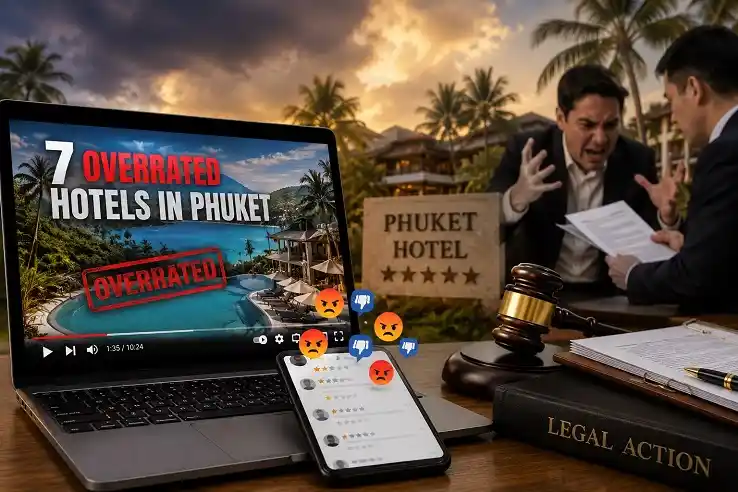
Image Credit: Phuket Hotel News
This Phuket Hotel News report examines a controversy that reaches well beyond the seven properties featured in the video. At its heart is an increasingly important question for Thailand’s tourism industry: can travelers, journalists and independent content creators publish strongly negative hotel reviews without becoming embroiled in potentially serious disputes?
Seven Phuket Hotels Put Under the Spotlight
The independently produced YouTube video presents the creator’s assessment of seven Phuket hotels considered by the creator to be overrated.
The video has attracted attention partly because Phuket’s hotel market is intensely competitive and online reputation can have a significant influence on booking decisions. A strongly worded YouTube video can potentially reach thousands of prospective visitors, making negative online coverage considerably more influential than it might have been a decade ago.
There have been reports within local hospitality circles that people associated with some of the properties are unhappy about the video’s contents and may be considering how to respond.
At the time of writing, however, no independently verified information has been obtained confirming that formal legal proceedings have been commenced in relation to the video.
The creator who has remained anonymous and has reportedly defended the content elsewhere online, maintaining that the assessments were honestly made and were not intended to defame the hotels concerned.
It has also been claimed that information and guest opinions appearing across a number of online hotel and travel review platforms were considered when the video was compiled. The methodology behind the rankings and the individual assessments contained in the video have not been independently verified.
The video at the center of the discussion was independently published on YouTube on the channel Travallion.
Due to possible legal ramifications, we are not allowed to post any direct link or embedded version of the video here. The rankings, descriptions and opinions expressed in the original video are those presented by its creator. Neither are we allowed to name any of the 7 hotels mentioned in the video.
The significance of the story lies not simply in which hotels were selected, but in the much broader debate it has generated about online criticism, independent hotel reviews and the responsibilities that come with publishing material capable of influencing travelers.
Can Travelers Still Publish Negative Hotel Reviews
That is arguably the most interesting question emerging from the controversy.
Online reviews have become fundamental to the way people choose hotels. Travelers routinely consult booking platforms, Google reviews, YouTube videos, travel websites and social media before deciding where to spend their money.
It would therefore be difficult to argue that only positive opinions should be published.
If somebody pays to stay at a hotel and believes the experience was disappointing, poor value or simply failed to meet expectations, that opinion can provide useful information to other travelers.
However, there is an important difference between expressing an opinion and making a factual allegation.
Saying that a hotel was disappointing, overpriced or overrated can represent a reviewer’s personal assessment. Making specific allegations concerning management, employees, safety, finances or business practices potentially enters very different territory.
Responsible reviewers consequently need to distinguish clearly between personal experiences, opinions collected from other travelers and statements presented as established facts.
Are Too Many Travel Reviews Simply Promotional
The controversy also raises another issue that many experienced travelers will recognize.
A considerable amount of contemporary hotel coverage is generated through complimentary stays, hosted meals, familiarization visits, sponsorship arrangements, advertising relationships and influencer collaborations.
There is nothing inherently improper about those arrangements when they are transparent. Hotels have worked with travel writers and media organizations for decades, and experiencing a property firsthand is an important part of producing meaningful travel coverage.
The difficulty arises when promotional relationships become indistinguishable from supposedly independent reviews.
Readers increasingly recognize content in which virtually every hotel is described as extraordinary, luxurious, breathtaking or highly recommended. If nothing is ever criticized, audiences may reasonably question whether they are reading an independent assessment or sophisticated advertising.
In fact, these days, most people with intelligence have stopped following influencers, blogs or travel and hotel websites that simply give positive reviews non-stop except individuals intellectually deficient or in most cases followed by lower life forms that in the first place cannot even afford to visit these properties!
Credible travel journalism should have room for both.
A genuinely outstanding property deserves praise. A disappointing experience should also be capable of being discussed responsibly.
Hotels Have a Legitimate Side to the Argument
Hotels, however, have an equally important interest in protecting their reputations.
Building a successful resort can require years of investment, thousands of employees and substantial expenditure on service, facilities and marketing. An inaccurate factual allegation circulated widely online can potentially have consequences extending far beyond a few negative comments.
Hotels therefore have every reason to challenge information they believe is demonstrably incorrect.
The same principle should apply to reviewers. Criticism does not need to disappear, but factual assertions should have a reasonable basis, while personal opinions should be presented as opinions rather than indisputable facts.
That distinction becomes particularly important as influencers and independent creators develop audiences capable of rivaling traditional travel publications.
Social Media Has Changed the Balance of Power
There was a time when a dissatisfied hotel guest might complain to management, tell friends about the experience and perhaps write a letter to a newspaper or travel magazine.
That world has disappeared. A guest can now upload a video from a hotel room and potentially reach an international audience before checking out.
YouTube, TikTok, Facebook, Instagram and other platforms have dramatically changed the balance of power between hospitality businesses and their customers.
That transformation has brought benefits. Hotels can receive immediate feedback, travelers have access to vastly more information, and independent creators can challenge polished marketing campaigns with firsthand experiences.
But that influence also carries responsibility. The larger the audience, the greater the potential consequences of inaccurate information.
A Controversy Bigger Than Seven Phuket Hotels
Whatever ultimately happens with this particular video, the debate is considerably bigger than the seven properties appearing in it.
The controversy highlights an uncomfortable but increasingly unavoidable reality for the modern hospitality industry: hotels can no longer completely control the conversation surrounding their brands.
Independent reviewers will sometimes publish opinions that management strongly disagrees with. At the same time, having an online audience does not remove a creator’s responsibility to distinguish between criticism, opinion, speculation and factual allegations.
That balance is likely to become increasingly important for Phuket as competition between hotels intensifies and travelers become ever more dependent on online information when planning holidays.
Honest Reviews Still Matter
Phuket benefits from having internationally respected hotels and resorts, but it also benefits from travelers having access to credible and genuinely independent information.
An online environment consisting entirely of glowing hotel recommendations would ultimately be of little value to consumers. Equally, an environment in which sensational or unsupported allegations can damage businesses without scrutiny would be unfair to the people who have invested in building those properties and their reputations.
The healthiest outcome lies somewhere between those extremes. Travelers should be able to express genuine opinions about their experiences, while content creators should recognize the responsibilities that accompany publishing material to large audiences. Hotels should be able to challenge information they believe is inaccurate, while accepting that legitimate criticism is an unavoidable part of operating in the digital age.
Ultimately, the controversy surrounding this video may prove more important for the questions it raises than for the seven hotels it discusses. Phuket’s tourism industry needs independent voices, responsible journalism, credible hotel operators and informed travelers. Preserving all four will require criticism to remain possible while ensuring that serious factual claims are treated with the care and evidence they deserve.