
Headlines surrounding Phuket’s hospitality sector remain dominated by billion-baht luxury launches, branded residences, and an incoming pipeline of more than 5,500 new hotel rooms. Yet beneath the surface of the island’s post-pandemic development boom, a quieter, far more consequential transfer of wealth is underway.
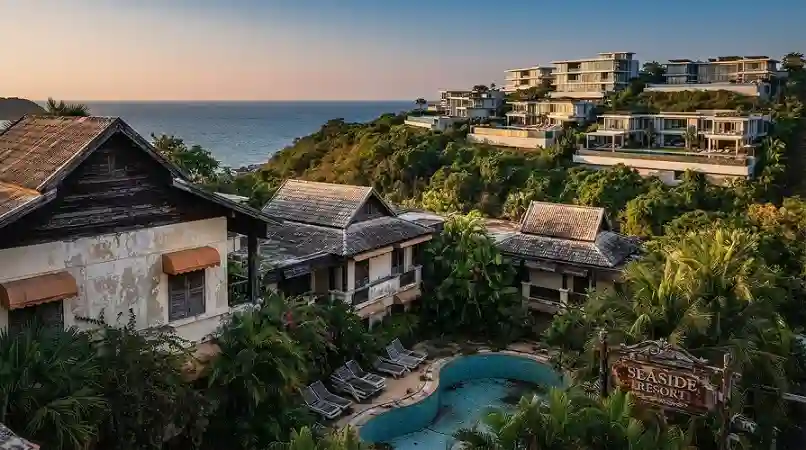
Image Credit: Phuket Hotel News
Across Phuket’s west coast, dozens of aging midscale resorts, independent boutique properties, and shuttered pandemic casualties are silently hitting the market. Commercial brokerage data and hospitality M&A filings uncovered by Phuket Hotel News indicate that more than 130 hotels and resorts across the island are currently available for outright sale or long-term lease takeover—signaling the end of an era for the family-run businesses that built Phuket’s tourism economy during the 2005–2015 boom.
For local owners, a convergence of expiring bank debt grace periods, soaring renovation requirements, and softening midscale occupancy has turned long-held family assets into financial burdens. For institutional investors and global hotel conglomerates, however, Phuket’s quiet distress represents the prime acquisition opportunity of the decade.
Three Tiers of Quiet Distress
A review of commercial property listings and boutique hotel brokerages across Phuket reveals three distinct categories of assets seeking exits:
• The Pandemic “Zombies”: Several large resorts that shuttered during the COVID-19 travel freeze have never reopened, leaving owners unable to fund the massive capital expenditure required to bring dormant buildings back to code. Among the prominent west-coast listings is a 262-room resort located just 150 meters from Patong Beach, currently priced at THB 1.2 billion—roughly THB 4.58 million per key. Having sat idle for years, such properties require complete mechanical, electrical, and plumbing overhauls, pricing out smaller domestic buyers and leaving them exclusively to institutional turnaround funds.
• The Aging Midscale Squeeze: Operational 15-to-20-year-old resorts in established hubs like Patong and Kamala are increasingly being marketed quietly to institutional buyers. Examples include a 169-room operational lagoon resort in Kamala priced near THB 1.6 billion and a 95-room Patong property listed at THB 1.5 billion. Many of these properties suffer from dated room layouts and expired 10-to-15-year management contracts. Unable to afford the mandatory Property Improvement Plans required by international operators—or compete against shiny new builds—owners are choosing to cash out.
• The Regulatory Exit: At the lower end of the market, dozens of 15-to-65-room guesthouses and older boutique hotels priced between THB 27 million and THB 120 million are being offloaded across Patong, Kata, and Phuket Town. Following recent fatal fires and intensified government inspections, authorities have cracked down on unlicensed conversions and missing fire escapes. Many independent owners operating without full permits under Thailand’s Hotel Act B.E. 2547 are choosing to sell rather than pay for costly structural retrofits.
Why Global Brands Want “Broken” Assets
The surge in quiet listings coincides with a strategic pivot by global hospitality giants. With prime beachfront land in Phuket nearly exhausted and greenfield construction costs at record highs, institutional buyers are increasingly bypassing ground-up development in favor of acquiring aging three- and four-star hotels and plugging them into global “conversion” brands.
Acquiring a distressed 200-room Patong or Kamala hotel at THB 4.5 million to THB 6 million per key and investing another THB 1.5 million to THB 2 million per key in renovations allows institutional funds to deliver a stabilized, internationally branded four-star property at a 30% to 40% discount compared to building from scratch.
This playbook was underscored last month when Marriott International signed a landmark seven-hotel portfolio deal with Thailand’s FICO Corporation, including the conversion of the 142-room Easy Planet Phuket Patong into Series by Marriott—a newly launched collection brand engineered specifically to absorb existing, character-led mid-market hotels without requiring structural rebuilds.
Simultaneously, cash-strapped local landlords unwilling to sell at a discount are turning to a growing shadow market of key-money lease takeovers. Brokers report a rise in three-to-nine-year operational leases—such as a 59-room Patong hotel seeking THB 5.9 million upfront plus roughly THB 583,000 in monthly rent—allowing owners to hand operational risk to regional management firms simply to cover bank debt service.
The Hidden Hurdles: Debt and Land Titles
Beneath the brokerage listings lie deeper structural pressures reshaping Phuket’s hospitality landscape. During the pandemic, Thai commercial banks extended generous debt-restructuring grace periods to struggling hoteliers. Many of those lifelines expired between 2025 and 2026 just as interest rates remained elevated and midscale occupancy softened—dropping sharply in mature markets like Kamala and Patong even as luxury enclaves pushed room rates higher.
Yet acquiring these distressed assets is rarely straightforward. Many older resorts in Kamala and Patong sit on Nor Sor 3 Gor land titles—a confirmed certificate of use—rather than full Chanote freehold deeds. Foreign-backed private equity funds frequently walk away during due diligence over boundary and encroachment risks, creating a two-tier market in which domestic Thai conglomerates hold a decisive advantage.
As 85% of Phuket’s incoming hotel pipeline shifts toward international management, this quiet wave of midscale acquisitions accelerates a broader transformation. While Phuket’s skyline continues to glitter with ultra-luxury announcements, the island’s middle tier is steadily consolidating—trading family-run independence for global flagships, one quiet sale at a time.