
Phuket Hotel News: As global uncertainty continues to challenge businesses across every sector, Siam Commercial Bank (SCB) is reinforcing its commitment to Thailand’s tourism industry by expanding its green lending programme for hotels in Phuket. At a time when geopolitical tensions, environmental concerns, natural disasters and changing travel patterns continue to reshape the global economy, the bank believes sustainable hospitality has become one of the strongest foundations for long-term economic growth.

Image Credit: Kata Group
This Phuket Hotel News report examines how SCB is helping drive the transformation of Phuket’s hotel industry by supporting environmentally responsible tourism through innovative financing, while encouraging hotels of every size to adopt sustainable business practices that lower operating costs, attract higher-spending guests and strengthen long-term competitiveness.
Sustainability Takes Centre Stage
According to SCB Chief Executive Officer Kris Chantanothok, businesses today face countless uncertainties, but one challenge is unavoidable and will ultimately affect everyone on the planet — the environmental crisis.
The bank believes sustainability is no longer simply an environmental responsibility. It has become an essential business strategy capable of improving financial performance while protecting natural resources and strengthening long-term resilience.
That strategy is already delivering measurable results.
Between 2023 and the first half of 2025, SCB provided more than 180 billion baht in sustainability loans and green bond issuances, exceeding its original three-year target of 150 billion baht well ahead of schedule. The achievement demonstrates the bank’s determination to help accelerate Thailand’s transition towards a greener economy.
Phuket Chosen to Lead the Way
SCB recently invited journalists to Phuket to showcase how sustainable financing is already making a tangible difference to the island’s hospitality industry.
During the visit, the media toured two leading hotel groups—Kata Group and Yee Teng Hospitality—which have successfully integrated sustainability into their operations with support from SCB’s financing and advisory programs.
Phuket was selected because it remains Thailand’s most important tourism destination and one of the country’s strongest economic drivers.
Tourism generated more than 2.6 trillion baht in revenue during 2024, contributing around 14 percent of Thailand’s Gross Domestic Product. Phuket alone accounted for more than 490 billion baht, reinforcing its position as the heart of the nation’s tourism economy.
The island has also continued to outperform national tourism trends.
During the first five months of 2025, Thailand welcomed 14.4 million international visitors, representing a decline of approximately three percent compared with the previous year. In contrast, Phuket recorded more than 2.4 million international arrivals, an increase of around eight percent year-on-year.
Much of that growth has been driven by travelers from Europe, North America and the Middle East, markets known for longer stays and higher spending, providing significant benefits for hotels and tourism-related businesses throughout the province.
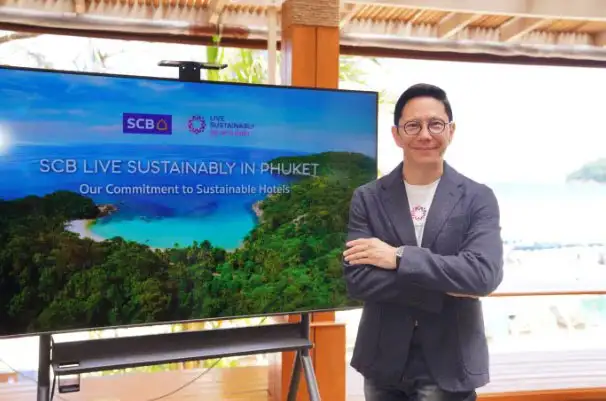
Image Credit: SCB
Green Tourism Becoming a Competitive Advantage
SCB believes sustainability has evolved into a powerful competitive advantage for hotels.
Research by Booking.com in 2025 found that more than 53 percent of travelers worldwide are concerned about the environmental and social impact of their holidays. Increasingly, visitors are seeking accommodation providers that demonstrate genuine commitments to sustainability and responsible tourism.
For Phuket’s hotels, adapting to these expectations offers several advantages.
Sustainable operations can reduce energy and water consumption, lower long-term operating expenses and enhance brand reputation while attracting environmentally conscious travelers who often spend more during their holidays.
Hotels embracing sustainability are also better positioned to diversify their customer base, reducing dependence on individual source markets while shifting the tourism model from prioritizing visitor numbers to focusing on higher-quality tourism experiences.
Phuket Building a Sustainable Tourism Future
The province is already playing a leading role in Thailand’s sustainable tourism ambitions.
Phuket has been designated as a pilot province under a national sustainable tourism development programme aimed at establishing the island as a recognized sustainable tourism hub by 2027.
Preparations are also underway for Phuket to host the Global Sustainable Tourism Conference in 2026, further strengthening its international profile as a destination committed to responsible tourism.
SCB’s own investment in the sector reflects the importance of Phuket to the Thai economy.
The bank currently holds Thailand’s largest hotel lending portfolio, valued at approximately 135 billion baht. Around one quarter of that portfolio is concentrated in the Andaman region, with hotels in Phuket accounting for approximately 20 billion baht.
Expanding Green Lending to Smaller Hotels
While major hotel groups have embraced sustainability more quickly, SCB believes the next stage of growth will come from supporting small and medium-sized hotel operators.
Many independent businesses remain uncertain whether investing in sustainable technologies will generate worthwhile returns or simply create additional costs.
To bridge that gap, SCB is focusing on education alongside financing.
The bank provides training programmes, workshops and expert guidance to help entrepreneurs understand how sustainability can reduce operating costs, improve business efficiency and strengthen long-term profitability without requiring excessive upfront investment.
Two Clear Pathways Towards Sustainability
SCB’s green hotel strategy focuses on two categories of businesses.
The first supports existing hotels beginning their sustainability journey.
Through its Less Brown approach, SCB connects businesses with sustainability specialists who help develop practical environmental strategies, improve energy efficiency, strengthen water management systems and introduce renewable energy solutions. Financing is then made available to support these improvements while laying the foundation for long-term business growth.
The second pathway is designed for hotels ready to achieve internationally recognized sustainability standards.
These businesses gain access to Sustainability Linked Loans, Green Loans and Green Bonds that reward measurable environmental performance while supporting internationally recognized certification programmes.
The bank also assists hotels pursuing sustainable building certifications including LEED, EDGE, WELL and TREES, together with internationally recognized operational certifications such as Green Hotel Plus, EarthCheck and GreenGlobe.
SCB hopes Phuket will become the national model for sustainable hotel development, encouraging similar initiatives throughout Thailand.
Hotel Leaders Showing What Is Possible
Among the strongest examples highlighted during SCB’s media visit was Kata Group, led by Chief Executive Officer Pramukpisit Achariyachai.
The company has earned 57 environmental awards from a variety of organizations, reflecting years of commitment to responsible hospitality and continuous environmental improvement.
Another standout example is Yee Teng Hospitality, led by 28-year-old Saharat Chiwawisithnont.
The company has embraced a philosophy of building environmentally responsible hotels from the ground up, believing sustainability has become the new benchmark for modern tourism, particularly among younger generations of international travelers.
Both hotel groups demonstrate that environmental responsibility can successfully complement commercial growth, offering practical examples for other tourism businesses looking to strengthen their competitiveness while protecting the environment.
SCB’s expanding green finance programme highlights a broader transformation taking place across Phuket’s hospitality sector. Banks, hotel operators, tourism businesses and local communities are increasingly recognizing that protecting the environment is no longer separate from protecting the future of tourism itself. As international travelers continue demanding more sustainable travel experiences, Phuket is well positioned to strengthen its reputation as one of Asia’s leading green tourism destinations. By combining financial innovation with environmental responsibility, the island is creating a model that balances economic growth with long-term sustainability, ensuring tourism continues to deliver lasting benefits for businesses, residents and visitors alike.
For more on SCB programmes for green hotels, visit:
https://www.scb.co.th/th/about-us/news/dec-2568/scb-g-green-hotel-plus
And for the latest developments in the hospitality industry in Phuket, keep on logging to Phuket Hotel News.